
While we are still recovering from the COVID-19 pandemic, a new virus outbreak in China’s Shandong and Henan provinces has raised global health concerns. The pathogen responsible for these outbreaks infecting 35 patients was recently identified as Langya Henipavirus (LayV), which was first reported in China in 2018.1 Of these, 26 patients were only infected with the Langya virus while six patients had SFTS virus co-infection simultaneously.2
According to a July study published in Current Opinion in the journal Virology, LayV infection in humans has a mortality rate of 50 to 100%, making it one of the deadliest viruses known to infect humans.3 On the other hand, Edward Holmes, an evolutionary virologist at Australia’s University of Sydney, has stated that while there is no reason to worry, ongoing surveillance is critical.1 Which of these statements is actually true? What exactly is this Langya virus? Should we be concerned about the outbreak of another epidemic?
In the following blog, we will try to understand how this virus spreads and whether it has the potential to cause another global pandemic.
Langya virus belongs to the Paramyxovirus family (genus Henipavirus). Its genetic composition is most similar to that of the Mojiang henipavirus (MojV)1 which has been suspected to cause severe pneumonia in infected patients.5
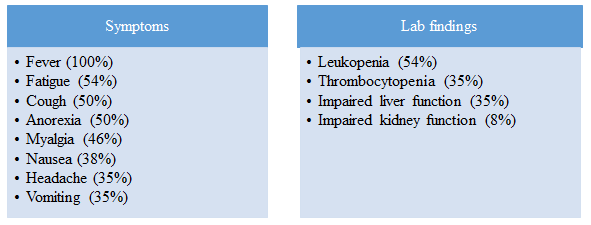
The majority of LayV virus-infected patients experienced fever (100%), fatigue (54%), and cough (50%), among other symptoms as shown in Figure 1. In addition, the presence of leukopenia in about 54% of the patients suggests that the virus may affect the leucocytes more. As a result, the immune systems of the patients may become weak, making them susceptible to other infections.4
Furthermore, most patients were farmers with a history of contact with animals within a month of the appearance of their symptoms. When a serologic survey of the blood and urine of 25 species of animals was conducted, it was found that almost 27% of shrews tested positive for the virus without showing any symptoms. Hence, they may be the “natural reservoirs” of LayV. As to how this virus was transmitted to humans, it is currently unknown.1
The natural reservoir of other known henipaviruses like Hendra virus (HeV) and Nipah virus (NiV) is Pteropus species fruit bats. Both the viruses cause a highly fatal, acute febrile illness with respiratory symptoms. They are shed in urine and respiratory secretions during the acute phase. In fact, people were infected even while handling the dead bodies of deceased patients without following proper infection control precautions. However, no evidence was found for human-to-human transmission of the Hendra virus.6 Is it the same for LayV?
It was reported that in June 2012, three mine-workers died of severe pneumonia of an unknown cause. The researchers found MojV virus in 3 of the 9 anal swab samples and 1 of the 3 tissue samples from the R. flavipectus rats. On the other hand, the samples from R. ferrumequinum bats and C. dracula musk shrews were found to be negative for MojV. So it can be inferred that R. flavipectus rats may be the natural reservoir of MojV.5
This study shows that, in addition to bats, other mammals are susceptible to Henipavirus spp. viruses and may act as reservoirs for them. As a result, the likelihood of shrews being LayV virus reservoirs is quite high. So, serological surveys must be initiated on all relevant mammals to identify the reservoirs and the mode of transmission of these viruses. Furthermore, most henipaviruses cause pneumonia and spread via droplet infection, implying that the LayV virus may do the same.
The researchers found that the contacts of the known LayV patients were all healthy, indicating that the rate of human-to-human transmission might be extremely low, as in the case of the Hendra virus. It has led scientists to believe that the Langya virus was spread to humans by animals such as shrews, dogs, and cats.
In addition, the infected patients had no contact with one another or with a common source of infection, implying that the outbreak was sporadic. Nonetheless, the sample size of the human-to-human transmission cohort is inadequate to rule out the possibility completely. Hence, its potential to cause another global outbreak should be investigated further in order to draw a meaningful conclusion.1
Most viruses mutate after coming into contact with the host’s genetic material, resulting in unexpected outcomes in infected humans. Therefore, though the Langya virus has been shown to cause minor illness in humans with no fatalities, researchers are suspicious of its virulence. That is why, efforts to understand the pathogenesis and transmission of this virus must be accelerated. Such information could be extremely useful in developing effective vaccines to combat any future disease outbreaks.
In conclusion, while there is no need to panic, it is wise to exercise caution when dealing with the Langya virus because there are currently no vaccines or drugs available to combat this disease. Additionally, efforts must be made to understand the possible causes of the recent spike in the number of diseases spreading from animals to humans. After all, it not only endangers our survival but also raises concerns about other living beings.
Reviewer: Priyanka
Copyright © 2025 All Rights Reserved