
Monkeypox, avian influenza A, and coronavirus variants: everyone must be wondering what else will befall us in 2022. According to recent reports, polio cases have been observed in different regions of the world, which has yet again gained the attention of medical researchers and organizations. Although it was thought to be eradicated completely, recent reports tell us otherwise.
Initially, the first outbreak of poliovirus was observed in 1952 in the United States (US), but it was in 1789 when Michael Underwood observed defective lower extremities in children in England due to this virus. The first vaccination was introduced in 1955 (inactivated polio vaccine, IPV), and the oral polio vaccine (OPV) in 1961.1
Hence, this virus has been around for centuries and has affected different regions worldwide at different intervals despite having the proper treatments and vaccines. Moreover, polio has been eradicated in several countries, but its recent traces have been seen in several countries. The global incidence of polio is on the rise.
In this blog, we’ll discuss the recent outbreaks of poliovirus, its possible causes, and what would be the government’s strategy to resolve the issues.
The first case reported this year was from Malawi, where a wild poliovirus 1 (WPV-1) strain infected a person. This was the first case reported in Africa in more than 5 years, while declaring Africa free from indigenous wild polio in August 2020.2
After this outbreak, a second case on May 15, 2022, in southern Africa was detected in Mozambique in a child. In Mozambique, this is the first single case since 1992. The virus was identified by the genomic sequencing analysis, which confirmed the virus to be of the WPV strain.
These cases raise the question of whether Africa is still polio free or not. The World Health Organization (WHO) still claimed the country as polio-free as the earlier cases in Malawi and Mozambique were found to be affected by a non-indigenous strain.3
Furthermore, on July 21, 2022, the first case in more than 30 years was reported in a young man in the US. The clinicians said that the virus affecting the person is related to the live OPV, which, interestingly, hasn’t been used in the US since 2000.4
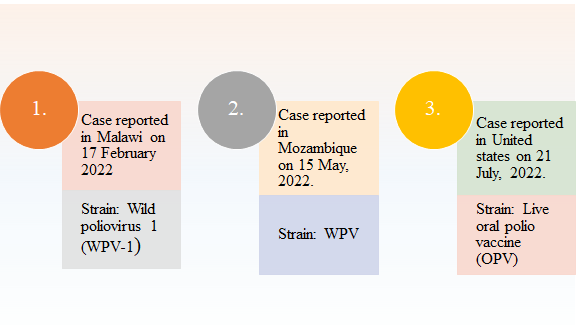
The WHO believes that these cases are somehow related to the frequent outbreaks of polio in Pakistan and Afghanistan. After the genomic sequencing, the newly confirmed cases in Malawi and Mozambique are connected to a strain of WPV1 that was circulating in Pakistan in 2019. In addition, WHO states that WPV is endemic in two countries: Pakistan and Afghanistan, and the finding of WPV1 outside of these two nations where the disease is endemic highlights the ongoing risk of worldwide disease transmission until the entire world is free of WPV1.5
According to a report by the Centers for Disease Control and Prevention (CDC), WPV1 has been continuously circulating in Pakistan and Afghanistan since 2017, after WPV2 and WPV3 were reported to be totally eradicated in 2015 and 2019, respectively.
In 2020, these nations reported the most WPV1 cases since 2014, as well as breakouts of type 2 circulating vaccine-derived poliovirus (cVDPV2). In Afghanistan, the incidence of WPV1 cases reported jumped by 93 % (from 29 in 2019 to 56 in 2020), with 308 cVDPV2 cases recorded.6
In Pakistan, the incidences of WPV1 in 2019 were a total of 147 (most of which were found in the Sindh district of Pakistan) and 84 cases in 2020, with 22 cases of cVDPV2 in 2019 and 135 in 2020.7
The graph below represents the number of cases (yearly) in Pakistan and Afghanistan of both strains: WPV1 and cVDPV2.8
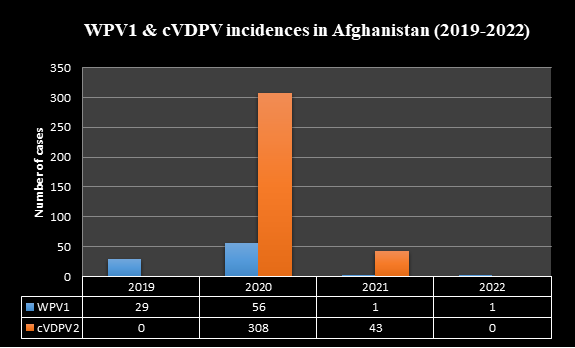
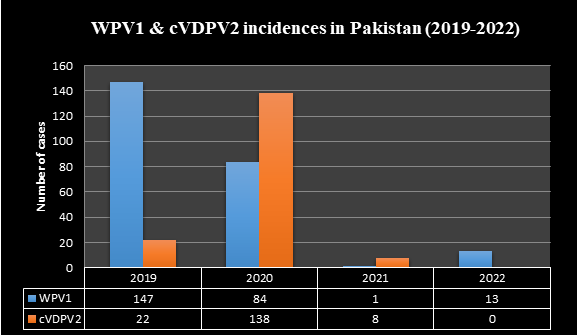
Although poliovirus eradication progress in these countries was halted or disrupted due to anti-government restrictions, the COVID-19 pandemic, and political and civil instability, polio eradication activities were resumed in 2021. Due to these strategies and approaches, the number of these cases of both strains has been reduced by 93% from 2020 to 2021; hence the decrease in incidences can be seen in 2022.9
However, WHO has suspected the circulation of these strains to other regions of the world due to which these previous outbreaks have happened. Can it be true? Moreover, reports from other regions indicate its existence or presence in their country due to other possibilities.
Recently, in London, the poliovirus was detected in sewage treatment works (London Beckton Sewage Treatment Works) as reported by the United Kingdom Security Agency (UKHSA), which was working with the Medicines and Healthcare Products Regulatory Agency (MHRA). During the investigation, several similar viruses were discovered in sewage samples obtained between February and May. Through time, the virus has evolved and is now known as “vaccine-derived” poliovirus type 2 (VDPV2), which can cause significant diseases, such as paralysis, in people who have not been properly vaccinated.10
Besides, on April 25, 2022, in Kolkata, state of India, VDPV-type 1 was detected from an environmental sewage sample collected from the Shyamlal Lane ES site. The isolation of the strain from the sewage sample demonstrates that India’s monitoring system is very sensitive and gives early warning of falling population immunity in a geographical area.11
Over the last three decades, the total global expenditure to eradicate poliovirus has exceeded the US $17 billion. The world has done its best to eradicate polio cases up to 99.9%, but the last few steps have proved to be difficult with all these recent outbreaks. At the end of 2020, WHO gave emergency clearance to develop nOPV2 vaccination to suppress cVDPV2 outbreaks in the Southern Hemisphere.12
A clinical trial was also conducted to evaluate the safety and immunogenicity of the monovalent oral polio vaccine (nOPV2). According to the results, the vaccine was safe to use, well tolerated, and immunogenic in children as well as in infants. It can be an important resource against poliovirus in this current epidemiological situation.13, 14
Although we have a proper vaccination plan, polio will not be wiped out from the world until proper eradication strategies and programs are implemented. Vaccine reluctance, political turmoil, and a lack of proper health infrastructure are all hurdles to global polio eradication programs. The international community should help low-income nations acquire vaccinations, improve surveillance, and empower front-line health personnel to provide every kid with immunizations.
Reviewer: Manisha
Copyright © 2025 All Rights Reserved