
In the last few years, a rise in patient data in the form of electronic health records (EHRs) and genetic information has resulted in the customization of treatment options according to the specific needs of the patients. Such targeted care is known as “precision medicine” which includes drugs and treatments designed for small groups, rather than large populations, based on certain characteristics such as genetic makeup, medical history, and data recorded in devices.
Physicians and organizations from small to large scale are using artificial intelligence (AI) and Blockchain technologies to develop personalized treatments for complex diseases. Their primary goal is to collect information from the vast amount of available data sets and gain insight into treatment options that can improve patients’ health on an individual level. Those visions could guide the development of new drugs, discover new uses, suggest customized combinations, and predict the risk associated with the disease.
Artificial intelligence and Blockchain shows great potential for precision medicine, however, the quality and feasibility of AI and Blockchain have often been constrained by limited data. In general, these limitations are typically caused by data being obtained from only one silo within a particular healthcare organization. Blockchain offers a pathway forward to advance AI by enabling the sharing of data and collaborating on the training as well as the testing of AI models across a group of healthcare organizations. Based on real genomics examples from several leading organizations, this white paper explains how advanced personalized medicine can be achieved through AI and Blockchain.




Artificial intelligence (AI) includes the utilization of software and complex algorithms for the estimation of human cognition to analyze complicated healthcare data. AI contains machine learning algorithms that obtain information, process it, and convert it into a well-defined output. Blockchain, on the other hand, is a data sharing system that securely shares data between groups without keeping a record of what was shared.
In the past few years, AI and Blockchain have increased productivity in various human endeavors, and AI their widespread adoption into the lives of people is also increasing at a rapid pace. AI and Blockchain are currently being discussed in nearly every domain of science as well as healthcare. In the United States, 85% of participants stated they use one of six gadgets with AI incorporated in them. AI and Blockchain are widespread in people’s lives and are constantly integrated into the gadgets, applications, and administrations they use, enabling them to make more informed decisions.
Major scientific competitions are providing confirmation that human-like competence can be achieved by computers in image recognition. Recently, some research papers have demonstrated that clinical diagnostics on medical images can be performed with the help of AI at levels equivalent to experienced clinicians. AI has also supported significant progress in natural language processing and speech recognition. These advances have opened questions about the capabilities of AI and Blockchain to support and enhance human decision-making in the health care industry. There is an abundance of data available in healthcare domains.
Blockchain innovation has grown impressively, with increased enthusiasm for a wide range of applications, including information management, financial administrations, digital security, the internet of things (IoT), and food science, as well as the healthcare industry and brain research. There has been a striking interest in the utilization of Blockchain for the delivery of safe and secure healthcare information management.
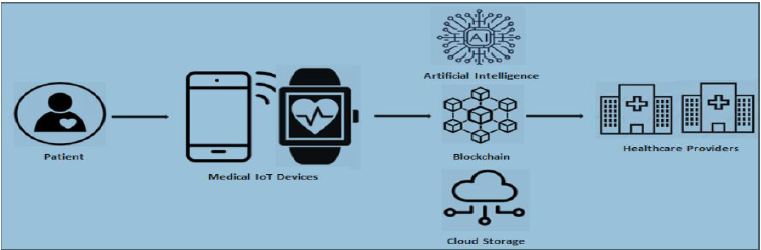
There are a few factors that drive the incorporation of technology in the healthcare sector. AI controlled arrangements addresses real-world difficulties that the healthcare sector faces. Currently, the demand for diagnostic services exceeds the supply of specialists in the workforce. The development of solutions for the management of this workload is a significant task for the healthcare sector.While the remaining task at hand is being developed, diagnostics and treatment are likewise becoming increasingly complex. Doctors and diagnostic experts need another arrangement of devices that can deal with enormous volumes of medicinal information rapidly and precisely. This would take into account increasingly targeted treatment options based on quantitative data and tailored to the needs of each patient. To provide this new set of tools, the healthcare industry must tap into the power of AI.
In spite of the widespread digitalization of records, the acceptance of precision medicine has been slowed by the absence of data exchange. The advancement of storage systems and data formats has been sporadic until now. Thus, many healthcare organizations regularly keep up various non-compatible data structures that result in the restriction of data sharing and create huge issues for communication. Information communication between medical services suppliers is constrained to such an extent that right around 33% of patients report having to physically bring their medical records from one provider to another.
Every year, enormous amount of unstructured information – including billions of faxes, are transmitted in the United States medical services system. Because this out of date information are so hard to combine, the majority of patients report that their medical record is incomplete. The absence of powerful data sharing innovations prompts considerable wasteful aspects and data gaps. Even when data is shared, providers come up short on the framework to adequately coordinate, and analyze the data. Poor exchange of data restrains coordination of care in spite of providers great efforts making them invest energy in administrative assignments. Doctor’s report investing practically 50% of their energy in preparing records, finding out the missing data, and filling out the forms.
Clay Christensen’s model of medicine based on the spectrum of weak to better understanding of medicine from his book “The Innovator’s Prescription” is a helpful theory to understand the potential of AI and Blockchain in healthcare. The theory begins with ‘intuitive medicine,’ categorized by the physicians who hold everything within their minds and use different tools to provide the best care possible given a complete understanding of the diseases and therapies.
‘Empirical medicine’ begins when enough high-quality information is collected to establish patterns that strengthen or weaken competing diagnostic and treatment theories. Finally, ‘precision medicine’ arrives with a clear understanding of pathology, diagnosis, and treatment. It is widely accepted by healthcare professionals. Ear infections and common colds are two conditions firmly within this realm; they are
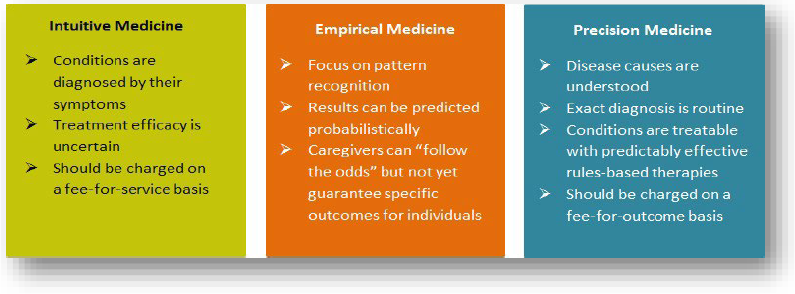
easily identified, diagnosed, and often treated with nothing more than a single pharmacy visit. When a medical condition is well understood, the therapeutic network can develop standardized conventions and calculations to characterize algorithms and work protocol. These algorithms and work protocols become increasingly refined as they are repeated several times, in the long run, they get tedious. This is the place where innovation can intercede.
In general, AI will, assume control over the simplest, most repeatable, and most repetitive undertakings from people first; in this manner, effective AI in human services will probably first develop for applications that have reached a certain level of careless repetition. Almost all the organizations, ranging from the most significant to small university-led government funded are utilizing computerized AI to create personalized medications for complex diseases. Their focal point is to gather information from progressively enormous and accessible informational collections knowledge into what makes patients healthy at the individual level. Those bits of knowledge could manage the improvement of new drugs, propose personalized combinations, and predict the risks related to the disease. By applying machine learning and AI to various data sources such as genetic data, sensor data, environmental data, and lifestyle data, researchers are moving forward toward the development of personalized medicine for diseases ranging from cancer to depression. Past treatments, the current complexity of the disease, side effects—all of this information must be integrated in order to intelligently choose new treatment options. A variety of organizations are exploring and finding different methods to deal with precision medicine.
For example A Toronto-based group called “Deep Genomics” utilizes AI to diminish the number of errors in drug discovery and costly trials by analyzing a large number of genomic databases. However, its first clinical trial will probably take place after 2020.
With a developing pattern in medicine toward personalized medicine and patient- focused care, traditional health information technology restricts progress. With high administrative costs and a lack of universal data access, modern electronic healthcare records serve the institution rather than the patient. Blockchain innovation was at first produced for use in money-related markets, filling in as a decentralized, circulated record of exchanges. However, this innovation’s inherent characteristics make it suitable for use in the healthcare sector. Potential applications of the Blockchain in the drug industry incorporate interoperable healthcare information access, information stockpiling and security, payment mechanisms, and supply chain effectiveness. The implementation of Blockchain addresses four key issues mentioned in the below figure:
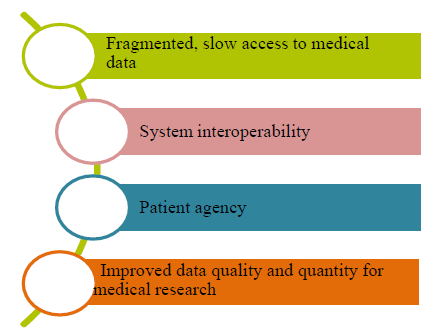
A few qualities of a Blockchain infrastructure include an increasingly secure information support framework, contrasted with other models. Firstly, the Blockchain framework, on a fundamental level, records a permanent history of exchanges. At the point when a patient’s information is accessed, that event is fused into the permanent chain, which is then updated on all hubs throughout the system.
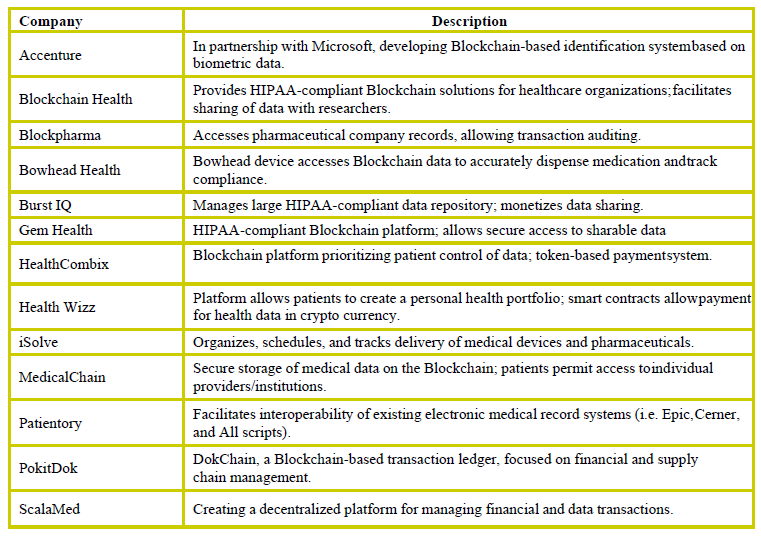
Secondly, information inside the blocks is encoded when added to the chain, to such an extent that an outside member cannot translate the inside information. Third, transactions within a blockchain are authorized using a private ID key that is only known to one person. Maintaining an identification source using Blockchain is similar to traditional identification verification. Individuals have their identities confirmed with the help of a combination of personal, financial, and government records. However, by leveraging Blockchain technology, this verification can be stored and utilized indefinitely. For patients, this can be used when attending appointments or for any pharmaceutical pick-up. For physicians, this can be used forcredentialing and licensing verification and for the transfer of licenses across state lines. The Food and Drug Administration (FDA) recently announced a collaboration with IBM Watson Health to investigate the use of blockchain innovation in oncology. The organization will help coordinate information from various sources and give a 360-degree perspective on patients. The innovation will empower all members, including patients, to share information from electronic health records frameworks. The activity is relied upon to show the transformative capability of Blockchain innovation in empowering the revelation of new tranquilizers through evidence-based research, just as it improves healthcare results for patient populations. Also, several platforms are being developed by various pharmaceutical companies to address the ideal interoperability of electronic health records. Some of them are mentioned in Table 1
Artificial intelligence-powered chatbots help doctors in human services analysis through a progression of inquiries where clients select their answers from a predefined set of decisions and are then suggested a strategy inlike manner. A similar research study predicts that the success of chatbot associations with no human intervention will rise to 75% in 2022 from 12% in 2017. Knowledge management frameworks will become an essential part of chatbots for AI, where the necessary inquiries and answers will be gathered for the duration of a solution’s life, assisting in the chatbots’ learning procedure.
Artificial intelligence applications are used in the translation of lab results such as blood tests and genetic tests. These applications work with normal language handling to chat with the patients through a portable application.
Pathology concerns with disease diagnosis are dependent on the investigation of body fluids, such as blood and urine. The use of technology in medical services helps improve the endeavors in pathology, which are generally left to pathologists as they frequently need to assess various pictures to reach a conclusion about finding any abnormalities. With assistance from AI and Blockchain, pathologists’ endeavors arestreamlined, and the accuracy of basic leadership can be improved.
Artificial intelligence and Blockchain healthcare likewise discuss deep learning. Scientists are utilizing deep learning to figure out how to prepare machines to find tissues with tumor with a precision practically identical to that of a trained physicist. Deep learning has a unique advantage in disease classification because it can help achieve higher demonstrative precision than area specialists. One of the current applications of deep learning in human services is the identification of malignant growth from gene expression information. This utilization can be further explored in the oncology business today and in the future.
Face 2 gene is a genetic quest and reference application for doctors. In this arrangement, AI looks over the picture information of a patient’s face and spots indications of a genetic issue, for example, Down’s syndrome. Another similar arrangement is Moon created by Diploid which empowers early detection of uncommon diseases through its product, allowing specialists to begin early treatment.
Encrypgen provides a blockchain-based DNA marketplace that engages patients with their information by allowing them to list their data, make it visible to clinical analysts, and be paid for their information with digital currency (called DNA) in the event that analysts wish to purchase access to their data. Genomics Personalized Wellbeing, in collaboration with global genomics powerhouse Macrogen, provides additional opportunities for patients to participate in precision prescription and genomic tests.
In 2016, authors from the MIT Media Lab proposed a blockchain-based medical record management system called “MedRec”. This system utilizes a system of smart contracts that are maintained on the blockchain “Ethereum” to link to individual patients medical records. When suppliers’ inquiries are made into the blockchain, with express authorization from the patient, the data from HIPPA is encrypted, accessed from cloud storage, updated, and reincorporated into the blockchain.
Over the past few years, economic, demographic, technological, andenvironmental factors have been enhancing a digital revolution in the healthcare industry. The healthcare AI and blockchain market is expected to grow from $2.1 billion in 2018 to $36.1 billion by 2025, at a compound annual growth rate (CAGR) of 50.20% during the forecast period. Health information technology (IT) funding set a record in 2017, with AI, blockchain, and predictive analytics as the top technologies funded, with patient engagement and clinical decision support close behind. Total corporate funding for healthcare technology companies climbed to $820.6 million in 2018 reported an increase of 17.5% from the $698.4 million in 2017.
Innovations like AI and blockchain technologies have the potential to significantly accelerate precision medicine selection and development. Increasingly large and complex data sets available in the form of big data, and a growing need to reduce increasing healthcarecosts are driving the growth of the AI and blockchain markets. Improving computing power and the declining value of hardware are other key factors in the projected market growth. Artificial intelligence and blockchain are predominantly used in clinical research, robotic personal assistants, and big data analytics. Classic venture capitalists and corporate strategic investors are both investing generously in this space. The transition from a traditional one-size-fits-all model to a more customized and data-driven approach to therapeutic considerations can result in significant savings in terms of human services costs and the nature of results.
According to Accenture, AI and blockchain applications in healthcare could save the industry $150 billion per year by 2026.The healthcare market itself is projected to be worth $6.6 billion by 2021, which represents a massive compound annual growth rate of 40% since 2014 but also a modest investment when compared with the anticipated savings directly related to the adoption of AI and blockchain.
Reviewer: Manisha
Copyright © 2025 All Rights Reserved